Underground Cable Installation
Definition, Requirements, Classification and Construction
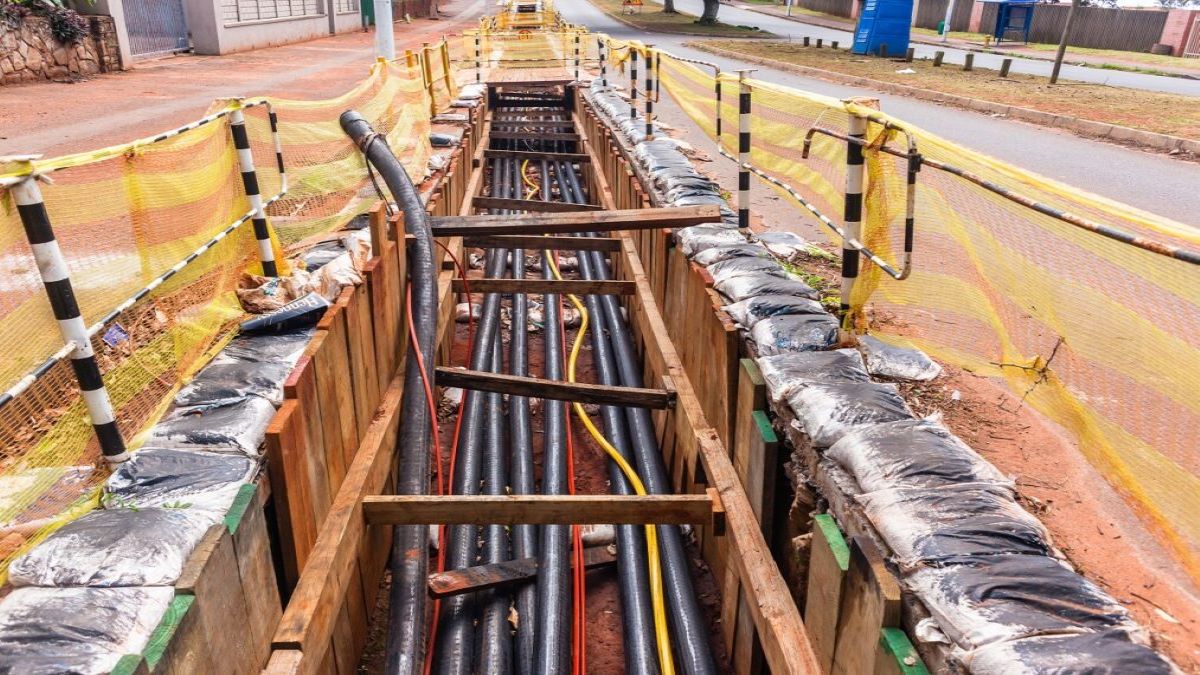
What is underground cable?
Underground cables are electrical power cables buried in the ground to transmit and distribute electricity.
They are commonly utilized in metropolitan locations where overhead power lines are impractical due to aesthetic or safety concerns.
Underground cables are generally insulated with materials like XLPE or EPR to protect them from moisture, corrosion, and other environmental concerns.
They have a variety of advantages over overhead lines, including less visual effect, lower maintenance requirements, and a lesser susceptibility to weather-induced outages.
Requirements of Underground Cable
The underground cables must fulfill the following requirements.
The conductor used in the cables must be stranded tinned copper (or) aluminum Stranding conductors are mainly used for obtaining more flexibility.
The size of the conductor should be reasonable so that the cable carries desired load current without overheating.
The cable must have a proper thickness of insulation to obtain proper safety and reliability.
The cable must be provided with suitable mechanical protection so that it may withstand rough uses only.
The materials used in cables should have more stability with respect to chemical and physical properties.
Classification of Underground Cables
The cables are mainly classified into different types according to
Number of conductors
Rating of Voltage
Nature of application of Insulation and Lead sheathing
Method of Improving the dielectric Stress
Construction of Different Underground Cables
A cable may be a single core (or) Multi-Core depending upon the type of service which it is intended to be used.
(L.T) Low Tension Underground Cables
Low tension cables are generally used up to 1000 volts, these cables are mainly of two types, namely
– Single core cables
– Multi-core cables
(H.T) High Tension Underground Cables
These cables are used for voltages up to 11 kV and these are generally to belted type cables.
Super Tension Cables (Screened Cables)
These cables are used for voltages up to 33KV. There are mainly available in two types namely:
– H-Type
– S.L. Type
Extra High Tension Cables
These types of cables are mainly used beyond 66 kV. The solid type cables are unreliable for beyond 66 kV because there is a danger of breakdown of insulation due to the presence of voids and it can be eliminated in pressure cables by increasing the pressure of the compound.